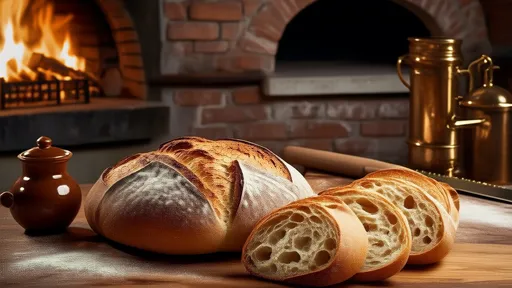
In the predawn hours of Paris, as the city still slumbers, a quiet ritual unfolds in countless boulangeries. Bakers measure, mix, and knead with a practiced rhythm, their hands working a dough of startling simplicity into what will become France's most iconic bread: the baguette. This daily creation is governed not by whimsy but by a specific and fiercely protected decree known as the French Bread Law (Décret Pain), established in 1993. At its heart lies a seemingly austere rule: a traditional baguette, worthy of the name baguette de tradition française, may contain only four ingredients—wheat flour, water, salt, and yeast. To understand this regulation is to delve into the soul of French baking, a story of cultural preservation, quality control, and a profound respect for craft.
The law did not emerge from a vacuum. For much of the 20th century, French bakers faced increasing pressure to industrialize. The post-war era saw the rise of factory bread, made with frozen dough, additives, and improvers designed to extend shelf life, hasten fermentation, and guarantee a uniform, puffy loaf. Supermarkets began to dominate sales, and the number of traditional, artisanal bakeries—the boulangeries de quartier—began a steep decline. A sense of alarm grew among master bakers and the public alike. The very symbol of French daily life, the baguette bought fresh every morning, was being eroded, its quality and character sacrificed for convenience and profit. The baguette was becoming a bland, generic product, a shadow of its former self.
In response, the government, under then-Prime Minister Édouard Balladur, intervened with the Décret n°93-1074 du 13 septembre 1993. This legislation was a bold move to draw a clear, legal line in the flour. It created a protected category for bread made on the premises in an artisanal way. Most famously, it strictly defined the composition of the baguette de tradition française. The decree explicitly states that this bread must be made only from the four basic ingredients. Any addition of additives, preservatives, or frozen dough is strictly forbidden. This was not merely a recipe; it was a declaration of principles. It was France's way of legally certifying authenticity and safeguarding a culinary heritage from the homogenizing forces of industrial food production.
The choice of these four ingredients is a testament to the philosophy that less is profoundly more. Each component plays a critical and irreplaceable role, and their purity is paramount. The wheat flour must be of high quality. While the law doesn't specify an exact type, traditional bakers often seek out specific varieties for their protein content and flavor. The flour provides the structure, the gluten network that traps the gases from fermentation and gives the bread its chewy crumb and airy alveolation.
Water hydrates the flour, allowing the gluten to form and the yeast to become active. Its mineral content can subtly influence the fermentation process and the final taste of the crust. Salt is far more than a simple flavor enhancer. It tightens the gluten structure, giving the dough strength and elasticity. It also regulates yeast activity, preventing over-fermentation, and contributes to a crispier, browner crust through its control over enzyme activity and moisture retention.
Finally, yeast (or sometimes natural leaven in combination with yeast) is the engine of the bread. This living organism feasts on the sugars in the flour, producing carbon dioxide gas that makes the dough rise and alcohol and organic acids that develop the bread's complex flavor profile. The law's prohibition of additives means bakers cannot rely on chemical leavening or dough conditioners like ascorbic acid (a common whitener and strengthener). They must achieve rise and flavor solely through the mastery of fermentation time and temperature.
The impact of this legislation has been multifaceted and significant. For consumers, it provides a guarantee. The label baguette de tradition française is a trusted sign of a traditionally crafted, additive-free product. It allows them to make an informed choice between an artisanal loaf and a more industrial one, often simply called a baguette ordinaire or baguette parisienne, which can contain a range of additives. This clarity has helped re-educate the public palate, fostering an appreciation for the superior crust, flavor, and texture of a true traditional baguette.
For the bakers themselves, the law is both a shield and a challenge. It protects them from unfair competition by mandating that any bread sold as "traditional" must adhere to the same strict rules, whether from a small bakery or a supermarket's in-store bakery. More importantly, it forces a return to fundamentals. Without the crutch of additives, a baker's skill becomes everything. The quality of the final loaf is directly tied to their expertise in kneading, the precise control of fermentation (often requiring a slow, cold rise), and the art of baking in a deck oven to achieve that signature crisp, blistered crust and irregular, honeycombed crumb. It celebrates the baker as a craftsman, not just a technician.
Of course, the law is not without its critics. Some argue it is overly restrictive and stifles innovation. Why shouldn't a talented baker be allowed to experiment with a fifth ingredient if it produces an excellent result? The counter-argument is that the law does not forbid experimentation; it simply forbids calling such a creation a baguette de tradition française. A baker is free to make a multigrain baguette, a seeded baguette, or a baguette with olive oil—they just must market it under a different name. The law protects the definition of the classic, much like the Appellation d'Origine Contrôlée (AOC) system protects regional wines and cheeses. It ensures that when a Parisian, a tourist, or anyone anywhere in France asks for a tradition, they know exactly what they are getting.
The cultural resonance of this simple list of ingredients extends far beyond the bakery counter. The baguette is woven into the daily rhythm of French life. Its crackle as it’s broken for breakfast, its role in a jambon-beurre sandwich at lunch, its presence beside a steak-frites at dinner—these are national rituals. The 1993 law ensures that this experience remains authentic. It is a statement that some cultural treasures are too valuable to be compromised, that tradition holds a weight equal to innovation. In 2022, the cultural significance of the baguette was recognized globally when the artisanal know-how and culture of the baguette were inscribed on UNESCO's Representative List of the Intangible Cultural Heritage of Humanity. This honor was not just for the bread itself, but for the community of bakers and the perpetual cycle of baking that the law helps to preserve.
Ultimately, the French bread law and its strict four-ingredient rule are about much more than baking. They represent a conscious choice to prioritize quality over quantity, craftsmanship over convenience, and cultural identity over globalization. It is a defense of a way of life. In a world of ever-increasing complexity and artificiality, the traditional French baguette stands as a powerful testament to the idea that perfection can be achieved through simplicity, patience, and respect for raw materials. Every crackly, golden, imperfectly perfect baguette de tradition is a small, daily victory for artisanal skill, a edible monument to the French conviction that the best things in life are, indeed, pure and simple.

By /Aug 29, 2025

By /Aug 29, 2025

By /Aug 29, 2025
By /Aug 29, 2025

By /Aug 29, 2025

By /Aug 29, 2025

By /Aug 29, 2025
By /Aug 29, 2025
By /Aug 29, 2025

By /Aug 29, 2025

By /Aug 29, 2025

By /Aug 29, 2025
By /Aug 29, 2025
By /Aug 29, 2025

By /Aug 29, 2025
By /Aug 29, 2025

By /Aug 29, 2025

By /Aug 29, 2025
By /Aug 29, 2025
By /Aug 29, 2025