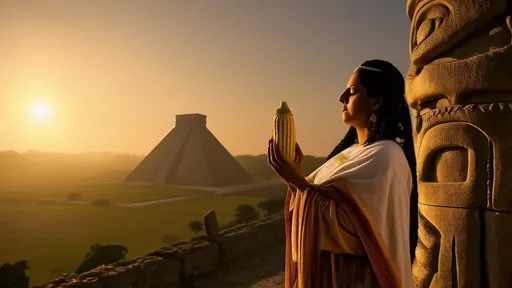
In the heart of Mesoamerica, where the sun casts long shadows over ancient pyramids and the air hums with the whispers of forgotten gods, lies the story of a civilization built upon a golden kernel. The tale of maize in Mexico is not merely one of agricultural development but a profound narrative woven into the very fabric of human existence, spirituality, and cultural evolution. From mythical origins to its modern-day incarnation in the global phenomenon of taco culture, maize has been both a sustainer of life and a symbol of identity for the Mexican people.
Long before the first cities rose from the fertile soil, maize was already enshrined in myth. The Popol Vuh, the sacred text of the K'iche' Maya, recounts how the gods fashioned humanity from maize dough after failed attempts with mud and wood. This divine origin story underscores the sacredness of the crop, positioning it not as a mere food source but as the substance of life itself. For the Olmecs, often regarded as the mother culture of Mesoamerica, maize deities began to emerge, depicted with elongated heads resembling corn cobs, their images carved into stone and jade. These early beliefs laid a spiritual foundation that would permeate all subsequent civilizations in the region.
As societies grew more complex, so did their relationship with maize. The Maya, with their advanced understanding of astronomy and mathematics, developed sophisticated agricultural techniques such as slash-and-burn farming and terracing to cultivate maize across diverse landscapes. It became the staple of their diet, ground into dough for tortillas and boiled in water with lime to release niacin, preventing malnutrition. But its importance extended beyond nutrition; the maize cycle dictated the rhythm of life, influencing calendars, ceremonies, and even political power. Rulers often depicted themselves as maize gods, reinforcing their divine right to rule through association with this life-giving force.
The Aztec Empire elevated maize to central stage in both economy and cosmology. In Tenochtitlan, the bustling capital built on a lake, chinampas or floating gardens produced abundant harvests that fed a massive population. Maize was so vital that it served as currency, tribute, and offering to the gods. Particularly significant was the worship of Centeotl, the maize deity, and the annual festival of Huey Tozoztli, where young maize ears were blessed to ensure a bountiful harvest. The Aztecs believed that maize required human sacrifice to thrive, a belief that tied agricultural cycles to the stark realities of their religious practices.
With the Spanish conquest in the 16th century, maize faced its greatest challenge yet. European colonizers viewed the crop with suspicion, associating it with indigenous "pagan" practices. They attempted to replace maize with wheat, a grain that held biblical significance and European prestige. Yet, maize persisted, not only because of its adaptability and nutritional value but due to its deep cultural roots. It became a food of resistance, a silent testament to survival amidst cultural upheaval. The Columbian Exchange eventually carried maize to the rest of the world, transforming global agriculture, but in Mexico, it remained the soul of the cuisine.
The post-colonial era saw maize further embedded in the national identity. During the Mexican Revolution, Emiliano Zapata’s cry for "Tierra y Libertad" (Land and Liberty) was as much about the right to grow maize as it was about political freedom. The 20th century brought industrialization and the Green Revolution, which introduced hybrid strains to increase yield but also threatened native varieties. Grassroots movements emerged to preserve heirloom corn, recognizing that biodiversity was key to both cultural heritage and food security. Artists like Diego Rivera muralized maize, depicting it as the backbone of Mexican society, from pre-Hispanic times to the modern era.
In contemporary Mexico, maize is at the heart of a culinary revolution that has taken the world by storm: taco culture. The taco, in its simplest form, is a tortilla wrapped around a filling, but it represents centuries of evolution. Street vendors and high-end chefs alike celebrate the versatility of maize, from blue-corn tortillas to crispy shells. Tacos al pastor, with their Lebanese-Mexican fusion, tell a story of migration and adaptation, while traditional tacos de guisado connect urban dwellers to rural traditions. The global popularity of tacos has turned them into an icon of Mexican culture, but also sparked debates about appropriation versus appreciation.
Yet, this success story is shadowed by challenges. The North American Free Trade Agreement (NAFTA) flooded Mexican markets with cheap, subsidized U.S. corn, undermining local farmers and threatening the diversity of native maize. Activists and organizations have fought to protect small-scale milpa farming, arguing that it is essential for environmental sustainability and cultural preservation. The rise of genetically modified maize has further polarized opinions, pitting technological progress against ancestral knowledge. In this struggle, the humble tortilla has become a political symbol, representing autonomy, health, and the right to cultural continuity.
Looking to the future, the story of Mexican maize civilization is far from over. Scientists are exploring the genetic richness of native varieties to address climate change and food security issues. Gastronomic innovators are rediscovering ancient recipes, incorporating pre-Hispanic ingredients like huitlacoche and chapulines into contemporary cuisine. Meanwhile, everyday Mexicans continue to gather around tables shared with bowls of pozole, plates of enchiladas, and stacks of warm tortillas, perpetuating a tradition that spans millennia. The golden kernel that once defined gods and empires now fuels a nation’s pride and palate.
From myth to modern plate, maize has been the constant thread in the tapestry of Mexican history. It has shaped civilizations, resisted colonization, inspired art, and fed revolutions. As the world bites into a crispy taco or savors the complex flavors of mole, they partake in a legacy that is both ancient and ever-evolving. The maize civilization endures, not as a relic of the past, but as a living, breathing culture that continues to grow, adapt, and nourish generations to come.

By /Aug 29, 2025

By /Aug 29, 2025

By /Aug 29, 2025
By /Aug 29, 2025
By /Aug 29, 2025

By /Aug 29, 2025

By /Aug 29, 2025
By /Aug 29, 2025
By /Aug 29, 2025
By /Aug 29, 2025
By /Aug 29, 2025
By /Aug 29, 2025
By /Aug 29, 2025
By /Aug 29, 2025
By /Aug 29, 2025
By /Aug 29, 2025
By /Aug 29, 2025
By /Aug 29, 2025
By /Aug 29, 2025
By /Aug 29, 2025
